Cluster Image Policies (CIP)
First, we need a new namespace that we want the controller to watch and label it appropriately:
oc new-project student-admission-test
oc label namespace student-admission-test policy.rhtas.com/include=true
Before we create a ClusterImagePolicy (CIP) let’s take a look at some important components and principles.
CIP Structure
Among a lot of other configuration options, the most important ones are the spec.images.glob[] (an image pattern) and the spec.authorities (used to validate signatures and attestations).
Image Patterns
The ClusterImagePolicy specifies spec.images which specifies a list of glob matching patterns. These matching patterns will be matched against the image digest of PodSpec resources attempting to be deployed.
The resource type that the policy matches the image against (default: PodSpec) can be changed, but with the default setting it will make sure that all higher-level k8s resources that make use of "PodSpec" (such as Deployments) will return an error if the policy denies an image.
|
Glob uses golang filepath semantics for matching the images against. Additionally you can specify a more traditional ** to match any number of characters.
apiVersion: policy.sigstore.dev/v1beta1
kind: ClusterImagePolicy
metadata:
  name: image-policy
spec:
  images:
- glob: "**" (1)| 1 | will match any image from any repository in any registry |
Authorities
When a policy is selected to be evaluated against the matched image (the namespace is being watched and the image matches the glob), the authorities will be used to validate signatures and attestations. If at least one authority is satisfied and a signature or attestation is validated, the policy is validated.
Authorities are combined as a boolean "or" (at least one is satisfied within a CIP).
There are different types of Authorities that can be used for validation of images and attestations:
-
keyvalidates against a static key provided-
inline
-
in a k8s
Secretin the namespace where thepolicy-controlleris installed -
in a KMS (Azure, AWS, GCP, HashiCorp Vault)
-
-
'keyless' validates against a
sigstore(Trusted Artifact Signer) installation -
staticdoesn’t validate anything, but instead is statically eitherpassorfail
Admission of Images
How does it work together when you define multiple policies with multiple authorities?
An image is admitted after it has been validated against all ClusterImagePolicy that matched the image (glob) and that there was at least one passing authority in each of the matched ClusterImagePolicy.
So each ClusterImagePolicy that matches is AND for admission, and within each ClusterImagePolicy authorities are OR.
Having three policies defined, an example of an allowed admission would be
If the image matched against
policy1andpolicy3A valid signature or attestation was obtained for
policy1with at least one of thepolicy1authoritiesA valid signature or attestation was obtained for
policy3with at least one of thepolicy3authoritiesThe image is admitted
An example of a denied admission would be:
If the image matched against
policy1andpolicy2A valid signature or attestation was obtained for
policy1with at least one of thepolicy1authoritiesNo valid signature or attestation was obtained for
policy2with at least one of thepolicy2authoritiesThe image is not admitted
By default, any image that does not match a policy is rejected!
A simple CIP
To try the PolicyController with the images we created, we’ll create a simple CIP:
-
matching all images (
glob: "**") -
a single
keylessauthority, pointing to our RHTAS instance
apiVersion: policy.sigstore.dev/v1beta1
kind: ClusterImagePolicy
metadata:
  name: cluster-image-policy
spec:
  images:
    - glob: "**" (1)
  authorities:
    - keyless:
        url: $FULCIO_URL (2)
        trustRootRef: $TRUST_ROOT_RESOURCE (3)
        identities:
          - issuer: $OIDC_ISSUER_URL (4)
            subject: $OIDC_SUBJECT (5)
      ctlog:
        url: $REKOR_URL (6)
trustRootRef: $TRUST_ROOT_RESOURCE (3)| 1 | This policy will match all images, from anywhere |
| 2 | The keyless authority will check for signature certificates issued by this fulcio endpoint |
| 3 | The TrustRoot CR we defined earlier |
| 4 | The verified OIDC identity needs to have come from this OIDC system |
| 5 | The subject is the OIDC identity, in our case pipeline-auth@demo.redhat.com |
| 6 | If we don’t provide a Transparency Log (rekor) endpoint, it will fall back to the public good instance of rekor. |
Create the CIP
We need to create the the ClusterImagePolicy in the policy-controller-operator namespace, and we’ll use the variables pointing to our pre-installed RHTAS again (since we keylessly signed one of the images with this RHTAS).
Remember, our "Podman Terminal" comes with these preconfigured, simply type help in the terminal to see the full list.
|
oc project policy-controller-operator
echo ""
echo "SIGSTORE_FULCIO_URL: ${SIGSTORE_FULCIO_URL}"
echo "SIGSTORE_REKOR_URL:  ${SIGSTORE_REKOR_URL}"
echo "OIDC_ISSUER_URL:     ${OIDC_ISSUER_URL}"
echo ""

cat <<EOF | oc apply -f -
apiVersion: policy.sigstore.dev/v1beta1
kind: ClusterImagePolicy
metadata:
  name: simple-cluster-image-policy
spec:
  images:
    - glob: "**"
  authorities:
    - keyless:
        url: $SIGSTORE_FULCIO_URL
        trustRootRef: trust-root
        identities:
          - issuer: $OIDC_ISSUER_URL
            subject: pipeline-auth@demo.redhat.com
      ctlog:
        url: $SIGSTORE_REKOR_URL
        trustRootRef: trust-root
EOF
Testing the CIP
We had labelled our student-admission-test namespace with policy.rhtas.com/include=true, so we’ll deploy into that one to verify if our policy is working.
oc get project student-admission-test -o jsonpath='{.metadata.labels}' | jq
{
  "kubernetes.io/metadata.name": "student-admission-test",
  "openshift-pipelines.tekton.dev/namespace-reconcile-version": "1.19.3",
  "pod-security.kubernetes.io/audit": "baseline",
  "pod-security.kubernetes.io/audit-version": "latest",
  "pod-security.kubernetes.io/warn": "baseline",
  "pod-security.kubernetes.io/warn-version": "latest",
  "policy.rhtas.com/include": "true"
}
When we created the images to test with, we stored an environment variable $IMAGE that contains the image and tag - we’ll use that for some testing. In each of the directories, we have a deploy.yaml, that contains a deployment, a service and a route for our simple test image:
apiVersion: apps/v1
kind: Deployment
metadata:
  name: unsigned-image
  labels:
    app: unsigned-image
spec:
  replicas: 1
  selector:
    matchLabels:
      app: unsigned-image
  template:
    metadata:
      labels:
        app: unsigned-image
    spec:
      containers:
      - name: unsigned-image
        image: $IMAGE
        ports:
        - containerPort: 8080
          protocol: TCP
So, we’ll use that and see what happens:
Unsigned Image
The one policy we have deployed matches all images and has one authority, checking for a keylessly signed image.
oc project student-admission-test
cd /workspace/l3-enablement-helpers/tas-tssc/controllers/sigstore/prep/unsigned-image
source image.env
echo ""
echo "IMAGE: ${IMAGE}"
sed "s|\$IMAGE|$IMAGE|g" deploy.yaml | oc apply -f -
IMAGE: quay-vtm4r.apps.cluster-vtm4r.dynamic.redhatworkshops.io/l3-students/l3-rhads-unsigned:2025-11-17_14-41
service/unsigned-image created
route.route.openshift.io/unsigned-image created
Error from server (BadRequest): error when creating "STDIN": admission webhook "policy.rhtas.com" denied the request: validation failed: failed policy: simple-cluster-image-policy: spec.template.spec.containers[0].image
quay-vtm4r.apps.cluster-vtm4r.dynamic.redhatworkshops.io/l3-students/l3-rhads-unsigned:2025-11-17_14-41@sha256:c3804ea119c09bdbc9d5e15321b3d63393829523dc9061f05ee0d6906fb2806d signature keyless validation failed for authority authority-0 for quay-vtm4r.apps.cluster-vtm4r.dynamic.redhatworkshops.io/l3-students/l3-rhads-unsigned@sha256:c3804ea119c09bdbc9d5e15321b3d63393829523dc9061f05ee0d6906fb2806d: no signatures foundAnd this is what we’d expect - no signatures found ✅
In other words - no unsigned image will make it to this namespace!
Signed with a key
oc project student-admission-test
cd /workspace/l3-enablement-helpers/tas-tssc/controllers/sigstore/prep/signed-image-keys
source image.env
echo ""
echo "IMAGE: ${IMAGE}"
sed "s|\$IMAGE|$IMAGE|g" deploy.yaml | oc apply -f -
IMAGE: quay-vtm4r.apps.cluster-vtm4r.dynamic.redhatworkshops.io/l3-students/l3-rhads-signed-key:2025-11-17_14-43
service/signed-image-key created
route.route.openshift.io/signed-image-key created
Error from server (BadRequest): error when creating "STDIN": admission webhook "policy.rhtas.com" denied the request: validation failed: failed policy: simple-cluster-image-policy: spec.template.spec.containers[0].image
quay-vtm4r.apps.cluster-vtm4r.dynamic.redhatworkshops.io/l3-students/l3-rhads-signed-key:2025-11-17_14-43@sha256:358b575f24615d8bfc096dae0d43649086b1b6235ecbae9f3c911bfc686c1824 signature keyless validation failed for authority authority-0 for quay-vtm4r.apps.cluster-vtm4r.dynamic.redhatworkshops.io/l3-students/l3-rhads-signed-key@sha256:358b575f24615d8bfc096dae0d43649086b1b6235ecbae9f3c911bfc686c1824: no matching signatures: error verifying bundle: nil certificate providedAgain, it worked - it recognises the signature but the authority we created can’t verify it: no matching signatures ✅
Keylessly Signed Image
We signed that keylessly with RHTAS and the subject (aka OIDC Identity) pipeline-auth@demo.redhat.com, which is what our authority expects:
oc project student-admission-test
cd /workspace/l3-enablement-helpers/tas-tssc/controllers/sigstore/prep/signed-image-keyless
source image.env
echo ""
echo "IMAGE: ${IMAGE}"
sed "s|\$IMAGE|$IMAGE|g" deploy.yaml | oc apply -f -
IMAGE: quay-vtm4r.apps.cluster-vtm4r.dynamic.redhatworkshops.io/l3-students/l3-rhads-signed-keylessly:2025-11-17_14-44
deployment.apps/signed-image-keyless created
service/signed-image-keyless created
route.route.openshift.io/signed-image-keyless created
Aaand, our image is admitted without further ado - it matched the policy’s glob and its signature could be verified against the authority, which defined the RHTAS endpoints and the subject that the image needed to be verified by.
And here’s more proof it made it onto our cluster. 😉
|
During image creation, we have made sure that the repositories on Quay are public. then the You can solve that by 1) using an image digest directly in your deployment resource (which is a good practice for production deployments anyway, as tags might change and you might want to control which exact image you’re deploying) 2) Granting the webhook access to the registry/repository by adding and linking a
|
Extending the CIP
Now that we have built and tested our first ClusterImagePolicy, we’ll change it a bit.
RegEx expressions
Similar to what we learned about cosign verify and its use of the --certificate-identity-regexp and --certificate-oidc-issuer-regexp options, we can do the same in our keyless authority, using issuerRegExp instead of issuer and subjectRegExp instead of subject, respectively.
If we wanted to admit all images signed by a Red Hatter that authenticated against any OIDC system running on the redhatworkshops.io domain:
spec:
  images:
    - glob: "**"
  authorities:
    - keyless:
        url: $SIGSTORE_FULCIO_URL
        trustRootRef: trust-root
        identities:
          - issuerRegExp: '\.redhatworkshops\.io/'
            subjectRegExp: '.*@.*redhat\.com$'
With that in mind, we’ll update our ClusterImagePolicy:
oc project policy-controller-operator
echo ""
echo "SIGSTORE_FULCIO_URL: ${SIGSTORE_FULCIO_URL}"
echo "SIGSTORE_REKOR_URL:  ${SIGSTORE_REKOR_URL}"
echo ""

cat <<EOF | oc apply -f -
apiVersion: policy.sigstore.dev/v1beta1
kind: ClusterImagePolicy
metadata:
  name: simple-cluster-image-policy
spec:
  images:
    - glob: "**"
  authorities:
    - keyless:
        url: $SIGSTORE_FULCIO_URL
        trustRootRef: trust-root
        identities:
          - issuerRegExp: '\.redhatworkshops\.io/'
            subjectRegExp: '.*@.*redhat\.com$'
      ctlog:
        url: $SIGSTORE_REKOR_URL
        trustRootRef: trust-root
EOF
Now, we can deploy our keylessly signed image again:
oc project student-admission-test
cd /workspace/l3-enablement-helpers/tas-tssc/controllers/sigstore/prep/signed-image-keyless
source image.env
echo ""
echo "IMAGE: ${IMAGE}"
sed "s|\$IMAGE|$IMAGE|g" deploy.yaml | oc apply -f -|
You might be wondering - the deploy.yaml hasn’t changed, so would it really validate if I deploy the same again? You can see that - even though the deployment hasn’t changed - it says
|
|
If you really want to verify that it worked
|
Images signed with a key
We learned earlier, that we can add more than one authority to an ClusterImagePolicy and these are combined with OR, meaning an image is admitted if
-
it matches the policies
globpattern -
at least one of the authorities can validate it
spec:
images:
- glob: "**"
authorities:
- keyless:
url: $SIGSTORE_FULCIO_URL
trustRootRef: trust-root
identities:
- issuerRegExp: '\.redhatworkshops\.io/'
subjectRegExp: '.*@.*redhat\.com$'
- key:
secretRef: (1)
name: secretName
ctlog: (2)
url: $SIGSTORE_REKOR_URL
trustRootRef: trust-root| 1 | The secretRef specifies the secret location name in the same namespace where policy-controller is installed. The first key value will be used in the secret. |
| 2 | ctlog is optional here - if omitted, it will just verify the signature against the public key in the secret. If provided, it will also verify that there is a corresponding entry in the transparency log (more secure). |
We signed our image with the cosign key that Tekton Chains is also using in its current "key-ful" configuration. Since the requirement for key authorities (if they use a k8s secret) is to have the secret in the policy-controller-operator namespace, we’ll have to copy it over:
cd /workspace/l3-enablement-helpers/tas-tssc/controllers/sigstore/config
./copy-signing-key.shoc describe secret chains-cosign-pubkey -n policy-controller-operator
Name: chains-cosign-pubkey
Namespace: policy-controller-operator
Labels: <none>
Annotations: <none>
Type: Opaque
Data
====
cosign.pub: 177 bytesWith the public key secret in place, we can modify our ClusterImagePolicy to add an authority:
oc project policy-controller-operator
echo ""
echo "SIGSTORE_FULCIO_URL: ${SIGSTORE_FULCIO_URL}"
echo "SIGSTORE_REKOR_URL: ${SIGSTORE_REKOR_URL}"
echo ""
cat <<EOF | oc apply -f -
apiVersion: policy.sigstore.dev/v1beta1
kind: ClusterImagePolicy
metadata:
name: simple-cluster-image-policy
spec:
images:
- glob: "**"
authorities:
- keyless:
url: $SIGSTORE_FULCIO_URL
trustRootRef: trust-root
identities:
- issuerRegExp: '\.redhatworkshops\.io/'
subjectRegExp: '.*@.*redhat\.com$'
ctlog:
url: $SIGSTORE_REKOR_URL
trustRootRef: trust-root
- key:
secretRef:
name: chains-cosign-pubkey
ctlog:
url: $SIGSTORE_REKOR_URL
trustRootRef: trust-root
EOFThe admission controller should now also allow images that have been signed by that cosign key:
oc project student-admission-test
cd /workspace/l3-enablement-helpers/tas-tssc/controllers/sigstore/prep/signed-image-keys
source image.env
echo ""
echo "IMAGE: ${IMAGE}"
sed "s|\$IMAGE|$IMAGE|g" deploy.yaml | oc apply -f -IMAGE: quay-vtm4r.apps.cluster-vtm4r.dynamic.redhatworkshops.io/l3-students/l3-rhads-signed-key:2025-11-17_14-43
deployment.apps/signed-image-key created (1)
service/signed-image-key unchanged
route.route.openshift.io/signed-image-key unchanged| 1 | The deployment of the "keyfully" signed image is now admitted. The service and route had been there from our previous try when the deployment was blocked. |
Attestations
Similar to Enterprise Contract (Conforma), the Sigstore Admission Controller can also check for the existence of signed attestations associated with that image. Since it checks if the attestation has been signed, it is part of the authority structure:
spec:
images:
- glob: "**"
authorities:
- name: keyless-no-attestation (1)
keyless:
url: $SIGSTORE_FULCIO_URL
trustRootRef: trust-root
identities:
- issuerRegExp: '\.redhatworkshops\.io/'
subjectRegExp: '.*@.*redhat\.com$'
- name: key-with-attestation-check (1)
key:
secretRef:
name: secretName
ctlog:
url: $SIGSTORE_REKOR_URL
trustRootRef: trust-root
attestations: (2)
- name: check-approval
predicateType: https://redhat.com/ads-scholars/v1| 1 | For more complex CIPs, it’a good idea to give authorities (and attestation checks) a name, since these will be part of error messages or warnings (instead of authority-0, authority-1 and so on.) |
| 2 | The attestations array - if included, each attestation must be present for the authority to approve the image |
Apply these changes (names) and additions (attestation check for the key authority) to our simple-cluster-image-policy:
oc project policy-controller-operator
echo ""
echo "SIGSTORE_FULCIO_URL: ${SIGSTORE_FULCIO_URL}"
echo "SIGSTORE_REKOR_URL: ${SIGSTORE_REKOR_URL}"
echo ""
cat <<EOF | oc apply -f -
apiVersion: policy.sigstore.dev/v1beta1
kind: ClusterImagePolicy
metadata:
name: simple-cluster-image-policy
spec:
images:
- glob: "**"
authorities:
- name: keyless-no-attestation
keyless:
url: $SIGSTORE_FULCIO_URL
trustRootRef: trust-root
identities:
- issuerRegExp: '\.redhatworkshops\.io/'
subjectRegExp: '.*@.*redhat\.com$'
ctlog:
url: $SIGSTORE_REKOR_URL
trustRootRef: trust-root
- name: key-with-attestation-check
key:
secretRef:
name: chains-cosign-pubkey
ctlog:
url: $SIGSTORE_REKOR_URL
trustRootRef: trust-root
attestations:
- name: check-approval
predicateType: https://redhat.com/ads-scholars/v1
EOFWith that change, we’ll check if our keylessly signed image will still be admitted (it should) and our "keyfully" signed image, but without the attestation works (it shouldn’t):
Keyless ✅
oc project student-admission-test
cd /workspace/l3-enablement-helpers/tas-tssc/controllers/sigstore/prep/signed-image-keyless
source image.env
echo ""
echo "IMAGE: ${IMAGE}"
sed "s|\$IMAGE|$IMAGE|g" deploy.yaml | oc apply -f -As expected, this works:
IMAGE: quay-vtm4r.apps.cluster-vtm4r.dynamic.redhatworkshops.io/l3-students/l3-rhads-signed-keylessly:2025-11-17_14-44
deployment.apps/signed-image-keyless configured (1)
service/signed-image-keyless unchanged
route.route.openshift.io/signed-image-keyless unchanged| 1 | Webhooks have been applied |
With Key but without attestation ❌
oc project student-admission-test
cd /workspace/l3-enablement-helpers/tas-tssc/controllers/sigstore/prep/signed-image-keys
source image.env
echo ""
echo "IMAGE: ${IMAGE}"
sed "s|\$IMAGE|$IMAGE|g" deploy.yaml | oc apply -f -And now - it is complaining about the missing attestation, as it should: no matching attestations - and also no matching signatures (of the attestation). ❌
IMAGE: quay-vtm4r.apps.cluster-vtm4r.dynamic.redhatworkshops.io/l3-students/l3-rhads-signed-key:2025-11-17_14-43
service/signed-image-key unchanged
route.route.openshift.io/signed-image-key unchanged
Error from server (BadRequest): error when applying patch:
{"spec":{"template":{"spec":{"$setElementOrder/containers":[{"name":"signed-image-key"}],"containers":[{"image":"quay-vtm4r.apps.cluster-vtm4r.dynamic.redhatworkshops.io/l3-students/l3-rhads-signed-key:2025-11-17_14-43","name":"signed-image-key"}]}}}}
to:
Resource: "apps/v1, Resource=deployments", GroupVersionKind: "apps/v1, Kind=Deployment"
Name: "signed-image-key", Namespace: "student-admission-test"
for: "STDIN": error when patching "STDIN": admission webhook "policy.rhtas.com" denied the request: validation failed: failed policy: simple-cluster-image-policy: spec.template.spec.containers[0].image
quay-vtm4r.apps.cluster-vtm4r.dynamic.redhatworkshops.io/l3-students/l3-rhads-signed-key:2025-11-17_14-43@sha256:358b575f24615d8bfc096dae0d43649086b1b6235ecbae9f3c911bfc686c1824 attestation key validation failed for authority key-with-attestation-check for quay-vtm4r.apps.cluster-vtm4r.dynamic.redhatworkshops.io/l3-students/l3-rhads-signed-key@sha256:358b575f24615d8bfc096dae0d43649086b1b6235ecbae9f3c911bfc686c1824: no matching attestations: signature keyless validation failed for authority keyless-no-attestation for quay-vtm4r.apps.cluster-vtm4r.dynamic.redhatworkshops.io/l3-students/l3-rhads-signed-key@sha256:358b575f24615d8bfc096dae0d43649086b1b6235ecbae9f3c911bfc686c1824: no matching signatures: error verifying bundle: nil certificate providedAdding an attestation
Similar to our previous exercise Building a custom attestation we’ll add our own attestation to the "keyfully" signed image.
|
You could also use an image that was signed and attested by Tekton Chains. In that case, you’d have to use the |
We’ll use the same attestation:
cd /workspace/l3-enablement-helpers/tas-tssc/controllers/sigstore
cat > release-approval-predicate.json <<'EOF'
{
"release": {
"approved": true,
"approvalDate": "2025-11-08T12:00:00Z",
"approver": "Jane Smith",
"approverEmail": "jane.smith@example.com"
},
"serviceNowTickets": [
{
"ticketId": "CHG0012345",
"url": "https://servicenow.example.com/nav_to.do?uri=change_request.do?sys_id=abc123",
"type": "Change Request",
"status": "Approved",
"approvalDate": "2025-11-07T15:30:00Z"
},
{
"ticketId": "RITM0067890",
"url": "https://servicenow.example.com/nav_to.do?uri=sc_req_item.do?sys_id=def456",
"type": "Requested Item",
"status": "Closed Complete",
"completionDate": "2025-11-08T09:00:00Z"
}
],
"metadata": {
"processVersion": "1.0",
"complianceFramework": "ADS-Scholars Release Policy",
"notes": "Standard release approval process completed"
}
}
EOFand we’ll attest it with the public/private key pair stored in the openshift-pipelines namespace - the same that we also used to sign the image.
source prep/signed-image-keys/image.env
cosign attest \
--key k8s://openshift-pipelines/signing-secrets \
--type https://redhat.com/ads-scholars/v1 \
--predicate release-approval-predicate.json \
$IMAGE|
If you restarted the terminal pod between exercises, you might have lost the cached |
If we now try to deploy it again, it will pass, since it has at least one signed attestation of the required type https://redhat.com/ads-scholars/v1
oc project student-admission-test
cd /workspace/l3-enablement-helpers/tas-tssc/controllers/sigstore/prep/signed-image-keys
source image.env
echo ""
echo "IMAGE: ${IMAGE}"
sed "s|\$IMAGE|$IMAGE|g" deploy.yaml | oc apply -f -IMAGE: quay-vtm4r.apps.cluster-vtm4r.dynamic.redhatworkshops.io/l3-students/l3-rhads-signed-key:2025-11-17_14-43
deployment.apps/signed-image-key configured
service/signed-image-key unchanged
route.route.openshift.io/signed-image-key unchangedNow it passed ✅👍
Adding a rego policy
So far, we have successfully verified that all images deployed to our student-admission-test are either
-
(keylessly) signed by a Red Hatter that was authenticated by any OIDC System ending with
redhatworkshops.io
or -
signed with a
cosignkey AND has a signed attestation of typehttps://redhat.com/ads-scholars/v1
Beyond checking for the existence of the attestation, we haven’t done anything with it. However, we can also apply a policy to the attestation (validate the attestation content).
We can extend the attestation in our ClusterImagePolicy with a policy that applies to attestation. (Yes, yes, yes - agreed. A policy inside a policy is a bit…cumbersome?)
spec:
images:
- glob: "**"
authorities:
- name: keyless-no-attestation
keyless:
url: $SIGSTORE_FULCIO_URL
trustRootRef: trust-root
identities:
- issuerRegExp: '\.redhatworkshops\.io/'
subjectRegExp: '.*@.*redhat\.com$'
- name: key-with-attestation-check
key:
secretRef:
name: secretName
ctlog:
url: $SIGSTORE_REKOR_URL
trustRootRef: trust-root
attestations:
- name: check-approval
predicateType: https://redhat.com/ads-scholars/v1
policy: (1)
type: rego (2)
data: | (3)
package sigstore
default isCompliant = false
isCompliant {
input.predicate.release.approved == true
}| 1 | For this attestation, we define an additional policy |
| 2 | We use rego as language. Available options are rego or cue |
| 3 | Here, we define an inline rego policy |
oc project policy-controller-operator
echo ""
echo "SIGSTORE_FULCIO_URL: ${SIGSTORE_FULCIO_URL}"
echo "SIGSTORE_REKOR_URL: ${SIGSTORE_REKOR_URL}"
echo ""
cat <<EOF | oc apply -f -
apiVersion: policy.sigstore.dev/v1beta1
kind: ClusterImagePolicy
metadata:
name: simple-cluster-image-policy
spec:
images:
- glob: "**"
authorities:
- name: keyless-no-attestation
keyless:
url: $SIGSTORE_FULCIO_URL
trustRootRef: trust-root
identities:
- issuerRegExp: '\.redhatworkshops\.io/'
subjectRegExp: '.*@.*redhat\.com$'
ctlog:
url: $SIGSTORE_REKOR_URL
trustRootRef: trust-root
- name: key-with-attestation-check
key:
secretRef:
name: chains-cosign-pubkey
ctlog:
url: $SIGSTORE_REKOR_URL
trustRootRef: trust-root
attestations:
- name: check-approval
predicateType: https://redhat.com/ads-scholars/v1
policy:
type: rego
data: |
package sigstore
default isCompliant = false
isCompliant {
input.predicate.release.approved == true
}
EOFNow we can try to deploy our image again - given that the attestation contains this section:
"release": {
"approved": true,
"approvalDate": "2025-11-08T12:00:00Z",
"approver": "Jane Smith",
"approverEmail": "jane.smith@example.com"
}We can expect this to pass.
oc project student-admission-test
cd /workspace/l3-enablement-helpers/tas-tssc/controllers/sigstore/prep/signed-image-keys
source image.env
echo ""
echo "IMAGE: ${IMAGE}"
sed "s|\$IMAGE|$IMAGE|g" deploy.yaml | oc apply -f -…which it does:
IMAGE: quay-vtm4r.apps.cluster-vtm4r.dynamic.redhatworkshops.io/l3-students/l3-rhads-signed-key:2025-11-17_14-43
deployment.apps/signed-image-key configured
service/signed-image-key unchanged
route.route.openshift.io/signed-image-key unchangedWe can modify our policy to validate a predicate field to force a fail (for sake of completeness):
oc project policy-controller-operator
echo ""
echo "SIGSTORE_FULCIO_URL: ${SIGSTORE_FULCIO_URL}"
echo "SIGSTORE_REKOR_URL: ${SIGSTORE_REKOR_URL}"
echo ""
cat <<EOF | oc apply -f -
apiVersion: policy.sigstore.dev/v1beta1
kind: ClusterImagePolicy
metadata:
name: simple-cluster-image-policy
spec:
images:
- glob: "**"
authorities:
- name: keyless-no-attestation
keyless:
url: $SIGSTORE_FULCIO_URL
trustRootRef: trust-root
identities:
- issuerRegExp: '\.redhatworkshops\.io/'
subjectRegExp: '.*@.*redhat\.com$'
ctlog:
url: $SIGSTORE_REKOR_URL
trustRootRef: trust-root
- name: key-with-attestation-check
key:
secretRef:
name: chains-cosign-pubkey
ctlog:
url: $SIGSTORE_REKOR_URL
trustRootRef: trust-root
attestations:
- name: check-approval
predicateType: https://redhat.com/ads-scholars/v1
policy:
type: rego
data: |
package sigstore
default isCompliant = false
isCompliant {
input.predicate.release.approved == true
input.predicate.release.approverEmail == "jane.doe@example.com"
}
EOFChecking with our image and attestation:
oc project student-admission-test
cd /workspace/l3-enablement-helpers/tas-tssc/controllers/sigstore/prep/signed-image-keys
source image.env
echo ""
echo "IMAGE: ${IMAGE}"
sed "s|\$IMAGE|$IMAGE|g" deploy.yaml | oc apply -f -As expected, it fails now: failed evaluating rego policy for type check-approval
Error from server (BadRequest): error when applying patch:
{"spec":{"template":{"spec":{"$setElementOrder/containers":[{"name":"signed-image-key"}],"containers":[{"image":"quay-vtm4r.apps.cluster-vtm4r.dynamic.redhatworkshops.io/l3-students/l3-rhads-signed-key:2025-11-17_14-43","name":"signed-image-key"}]}}}}
to:
Resource: "apps/v1, Resource=deployments", GroupVersionKind: "apps/v1, Kind=Deployment"
Name: "signed-image-key", Namespace: "student-admission-test"
for: "STDIN": error when patching "STDIN": admission webhook "policy.rhtas.com" denied the request: validation failed: failed policy: simple-cluster-image-policy: spec.template.spec.containers[0].image
quay-vtm4r.apps.cluster-vtm4r.dynamic.redhatworkshops.io/l3-students/l3-rhads-signed-key:2025-11-17_14-43@sha256:358b575f24615d8bfc096dae0d43649086b1b6235ecbae9f3c911bfc686c1824 failed evaluating rego policy for type check-approval: policy is not compliant for query 'isCompliant = data.sigstore.isCompliant' signature keyless validation failed for authority keyless-no-attestation for quay-vtm4r.apps.cluster-vtm4r.dynamic.redhatworkshops.io/l3-students/l3-rhads-signed-key@sha256:358b575f24615d8bfc096dae0d43649086b1b6235ecbae9f3c911bfc686c1824: no matching signatures: error verifying bundle: nil certificate provided|
If you look closely, it will also tell you that |
Complex rego policies
Let’s say (given our comparatively simple attestation) we’d like to have a more complex validation logic:
-
Does the attestation contain at least one ServiceNow Ticket?
-
For all ServiceNow Tickets:
-
If the ticket is a "Change Request" the status has to be "Approved"
-
If the ticket is a "Requested Item" the status has to be "Closed Complete"
-
we can encapsulate this inline as shown below - so please apply this slightly more complex ClusterImagePolicy:
oc project policy-controller-operator
echo ""
echo "SIGSTORE_FULCIO_URL: ${SIGSTORE_FULCIO_URL}"
echo "SIGSTORE_REKOR_URL: ${SIGSTORE_REKOR_URL}"
echo ""
cat <<EOF | oc apply -f -
apiVersion: policy.sigstore.dev/v1beta1
kind: ClusterImagePolicy
metadata:
name: simple-cluster-image-policy
spec:
images:
- glob: "**"
authorities:
- name: keyless-no-attestation
keyless:
url: $SIGSTORE_FULCIO_URL
trustRootRef: trust-root
identities:
- issuerRegExp: '\.redhatworkshops\.io/'
subjectRegExp: '.*@.*redhat\.com$'
ctlog:
url: $SIGSTORE_REKOR_URL
trustRootRef: trust-root
- name: key-with-attestation-check
key:
secretRef:
name: chains-cosign-pubkey
ctlog:
url: $SIGSTORE_REKOR_URL
trustRootRef: trust-root
attestations:
- name: check-approval
predicateType: https://redhat.com/ads-scholars/v1
policy:
type: rego
data: |
package sigstore
default isCompliant = false
isCompliant {
# Check that release is approved
input.predicate.release.approved == true
# Check that serviceNowTickets array exists and has at least one entry
count(input.predicate.serviceNowTickets) > 0
# Check that all tickets have valid status for their type
not any_invalid_ticket_status
}
# Helper rule: checks if ANY ticket has an invalid status
any_invalid_ticket_status {
ticket := input.predicate.serviceNowTickets[_]
not valid_ticket_status(ticket)
}
# Helper rule: validates ticket status based on type
valid_ticket_status(ticket) {
ticket.type == "Change Request"
ticket.status == "Approved"
}
valid_ticket_status(ticket) {
ticket.type == "Requested Item"
ticket.status == "Closed Complete"
}
EOF…and we also want to check if it is working (again, with our image & attestation):
oc project student-admission-test
cd /workspace/l3-enablement-helpers/tas-tssc/controllers/sigstore/prep/signed-image-keys
source image.env
echo ""
echo "IMAGE: ${IMAGE}"
sed "s|\$IMAGE|$IMAGE|g" deploy.yaml | oc apply -f -For a negative test (validation failed) for sake of completeness, open the section below, apply the policy and test:
Click & Expand
Details
The rego policy in this CIP will check for the status value "Closed" in the "Requested Item" ServiceNow Ticket attestation field. We know that it is (and has to be) "Closed Completed", so testing with the given attestation should fail.
oc project policy-controller-operator
echo ""
echo "SIGSTORE_FULCIO_URL: ${SIGSTORE_FULCIO_URL}"
echo "SIGSTORE_REKOR_URL: ${SIGSTORE_REKOR_URL}"
echo ""
cat <<EOF | oc apply -f -
apiVersion: policy.sigstore.dev/v1beta1
kind: ClusterImagePolicy
metadata:
name: simple-cluster-image-policy
spec:
images:
- glob: "**"
authorities:
- name: keyless-no-attestation
keyless:
url: $SIGSTORE_FULCIO_URL
trustRootRef: trust-root
identities:
- issuerRegExp: '\.redhatworkshops\.io/'
subjectRegExp: '.*@.*redhat\.com$'
ctlog:
url: $SIGSTORE_REKOR_URL
trustRootRef: trust-root
- name: key-with-attestation-check
key:
secretRef:
name: chains-cosign-pubkey
ctlog:
url: $SIGSTORE_REKOR_URL
trustRootRef: trust-root
attestations:
- name: check-approval
predicateType: https://redhat.com/ads-scholars/v1
policy:
type: rego
data: |
package sigstore
default isCompliant = false
isCompliant {
# Check that release is approved
input.predicate.release.approved == true
# Check that serviceNowTickets array exists and has at least one entry
count(input.predicate.serviceNowTickets) > 0
# Check that all tickets have valid status for their type
not any_invalid_ticket_status
}
# Helper rule: checks if ANY ticket has an invalid status
any_invalid_ticket_status {
ticket := input.predicate.serviceNowTickets[_]
not valid_ticket_status(ticket)
}
# Helper rule: validates ticket status based on type
valid_ticket_status(ticket) {
ticket.type == "Change Request"
ticket.status == "Approved"
}
valid_ticket_status(ticket) {
ticket.type == "Requested Item"
ticket.status == "Closed"
}
EOFAnd the test:
oc project student-admission-test
cd /workspace/l3-enablement-helpers/tas-tssc/controllers/sigstore/prep/signed-image-keys
source image.env
echo ""
echo "IMAGE: ${IMAGE}"
sed "s|\$IMAGE|$IMAGE|g" deploy.yaml | oc apply -f -As expected, it fails with evaluating rego policy for type check-approval: policy is not compliant
Error from server (BadRequest): error when applying patch:
{"spec":{"template":{"spec":{"$setElementOrder/containers":[{"name":"signed-image-key"}],"containers":[{"image":"quay-vtm4r.apps.cluster-vtm4r.dynamic.redhatworkshops.io/l3-students/l3-rhads-signed-key:2025-11-17_14-43","name":"signed-image-key"}]}}}}
to:
Resource: "apps/v1, Resource=deployments", GroupVersionKind: "apps/v1, Kind=Deployment"
Name: "signed-image-key", Namespace: "student-admission-test"
for: "STDIN": error when patching "STDIN": admission webhook "policy.rhtas.com" denied the request: validation failed: failed policy: simple-cluster-image-policy: spec.template.spec.containers[0].image
quay-vtm4r.apps.cluster-vtm4r.dynamic.redhatworkshops.io/l3-students/l3-rhads-signed-key:2025-11-17_14-43@sha256:358b575f24615d8bfc096dae0d43649086b1b6235ecbae9f3c911bfc686c1824 signature keyless validation failed for authority keyless-no-attestation for quay-vtm4r.apps.cluster-vtm4r.dynamic.redhatworkshops.io/l3-students/l3-rhads-signed-key@sha256:358b575f24615d8bfc096dae0d43649086b1b6235ecbae9f3c911bfc686c1824: no matching signatures: error verifying bundle: nil certificate provided failed evaluating rego policy for type check-approval: policy is not compliant for query 'isCompliant = data.sigstore.isCompliant'Externalising rego policies
For more complex rego policies, having those inline with the ClusterImagePolicy has two important drawbacks:
-
Management: Managing and testing more complex rego policies as inline rego code can become cumbersome
-
Coupling: If inline, you cannot manage or update them independently, also making re-use of the rego logic in more than one CIP impossible
Using ConfigMaps
We can externalise our rego logic by moving it to a configMap and then reference it from the ClusterImagePolicy:
- name: key-with-attestation-check
key:
secretRef:
name: chains-cosign-pubkey
ctlog:
url: $SIGSTORE_REKOR_URL
trustRootRef: trust-root
attestations:
- name: check-approval
predicateType: https://redhat.com/ads-scholars/v1
policy:
type: rego
configMapRef:
name: policy-config
key: approval-policyTo make that work, we need to create a configMap with our policy in the policy-controller-operator namespace:
We already have our above rego policy as a file approval-policy.rego in our helpers repository:
cd /workspace/l3-enablement-helpers/tas-tssc/controllers/sigstore
cat approval-policy.regoSo, we can create a configMap like this:
cd /workspace/l3-enablement-helpers/tas-tssc/controllers/sigstore
oc create configmap policy-config --from-file=approval-policy=approval-policy.rego \
-n policy-controller-operator
oc describe configmap policy-config -n policy-controller-operatorNow, apply our ClusterImagePolicy with the externalised rego policy:
oc project policy-controller-operator
echo ""
echo "SIGSTORE_FULCIO_URL: ${SIGSTORE_FULCIO_URL}"
echo "SIGSTORE_REKOR_URL: ${SIGSTORE_REKOR_URL}"
echo ""
cat <<EOF | oc apply -f -
apiVersion: policy.sigstore.dev/v1beta1
kind: ClusterImagePolicy
metadata:
name: simple-cluster-image-policy
spec:
images:
- glob: "**"
authorities:
- name: keyless-no-attestation
keyless:
url: $SIGSTORE_FULCIO_URL
trustRootRef: trust-root
identities:
- issuerRegExp: '\.redhatworkshops\.io/'
subjectRegExp: '.*@.*redhat\.com$'
ctlog:
url: $SIGSTORE_REKOR_URL
trustRootRef: trust-root
- name: key-with-attestation-check
key:
secretRef:
name: chains-cosign-pubkey
ctlog:
url: $SIGSTORE_REKOR_URL
trustRootRef: trust-root
attestations:
- name: check-approval
predicateType: https://redhat.com/ads-scholars/v1
policy:
type: rego
configMapRef:
name: policy-config
key: approval-policy
EOFand test if our validation still works:
oc project student-admission-test
cd /workspace/l3-enablement-helpers/tas-tssc/controllers/sigstore/prep/signed-image-keys
source image.env
echo ""
echo "IMAGE: ${IMAGE}"
sed "s|\$IMAGE|$IMAGE|g" deploy.yaml | oc apply -f -It does, as expected:
IMAGE: quay-vtm4r.apps.cluster-vtm4r.dynamic.redhatworkshops.io/l3-students/l3-rhads-signed-key:2025-11-17_14-43
deployment.apps/signed-image-key configured
service/signed-image-key unchanged
route.route.openshift.io/signed-image-key unchangedUsing URLs
Another option to externalise rego policies is by providing a https URL to fetch the rego policy from:
- name: key-with-attestation-check
key:
secretRef:
name: chains-cosign-pubkey
ctlog:
url: $SIGSTORE_REKOR_URL
trustRootRef: trust-root
attestations:
- name: check-approval
predicateType: https://redhat.com/ads-scholars/v1
policy:
type: rego
remote:
url: "https://raw.githubusercontent.com/redhat-tssc-tmm/l3-enablement-helpers/refs/heads/main/tas-tssc/controllers/sigstore/approval-policy.rego"
sha256sum: 5a5917ccad0eddf7d60375e5612d2913164828f8ac4be8ffbd7dc0d8e5fa5934|
For To get the fingerprint, use |
Let’s try this one:
oc project policy-controller-operator
echo ""
echo "SIGSTORE_FULCIO_URL: ${SIGSTORE_FULCIO_URL}"
echo "SIGSTORE_REKOR_URL: ${SIGSTORE_REKOR_URL}"
echo ""
cat <<EOF | oc apply -f -
apiVersion: policy.sigstore.dev/v1beta1
kind: ClusterImagePolicy
metadata:
name: simple-cluster-image-policy
spec:
images:
- glob: "**"
authorities:
- name: keyless-no-attestation
keyless:
url: $SIGSTORE_FULCIO_URL
trustRootRef: trust-root
identities:
- issuerRegExp: '\.redhatworkshops\.io/'
subjectRegExp: '.*@.*redhat\.com$'
ctlog:
url: $SIGSTORE_REKOR_URL
trustRootRef: trust-root
- name: key-with-attestation-check
key:
secretRef:
name: chains-cosign-pubkey
ctlog:
url: $SIGSTORE_REKOR_URL
trustRootRef: trust-root
attestations:
- name: check-approval
predicateType: https://redhat.com/ads-scholars/v1
policy:
type: rego
remote:
url: "https://raw.githubusercontent.com/redhat-tssc-tmm/l3-enablement-helpers/refs/heads/main/tas-tssc/controllers/sigstore/approval-policy.rego"
sha256sum: 5a5917ccad0eddf7d60375e5612d2913164828f8ac4be8ffbd7dc0d8e5fa5934
EOF…and test it again:
oc project student-admission-test
cd /workspace/l3-enablement-helpers/tas-tssc/controllers/sigstore/prep/signed-image-keys
source image.env
echo ""
echo "IMAGE: ${IMAGE}"
sed "s|\$IMAGE|$IMAGE|g" deploy.yaml | oc apply -f -IMAGE: quay-vtm4r.apps.cluster-vtm4r.dynamic.redhatworkshops.io/l3-students/l3-rhads-signed-key:2025-11-17_14-43
deployment.apps/signed-image-key configured
service/signed-image-key unchanged
route.route.openshift.io/signed-image-key unchangedTips & Tricks
Testing Policies with warn
To learn the impact of your policy before making it live across your cluster, you can configure the mode on the policy level. Allowed values are enforce (the default) or warn - which will admit the image, but issue a warning.
If we use that with our policy, we should be allowed to even deploy the unsigned image:
oc project policy-controller-operator
echo ""
echo "SIGSTORE_FULCIO_URL: ${SIGSTORE_FULCIO_URL}"
echo "SIGSTORE_REKOR_URL: ${SIGSTORE_REKOR_URL}"
echo ""
cat <<EOF | oc apply -f -
apiVersion: policy.sigstore.dev/v1beta1
kind: ClusterImagePolicy
metadata:
name: simple-cluster-image-policy
spec:
mode: warn (1)
images:
- glob: "**"
authorities:
- name: keyless-no-attestation
keyless:
url: $SIGSTORE_FULCIO_URL
trustRootRef: trust-root
identities:
- issuerRegExp: '\.redhatworkshops\.io/'
subjectRegExp: '.*@.*redhat\.com$'
ctlog:
url: $SIGSTORE_REKOR_URL
trustRootRef: trust-root
    - name: key-with-attestation-check
      key:
        secretRef:
          name: chains-cosign-pubkey
      ctlog:
        url: $SIGSTORE_REKOR_URL
        trustRootRef: trust-root
      attestations:
      - name: check-approval
        predicateType: https://redhat.com/ads-scholars/v1
        policy:
          type: rego
          remote:
            url: "https://raw.githubusercontent.com/redhat-tssc-tmm/l3-enablement-helpers/refs/heads/main/tas-tssc/controllers/sigstore/approval-policy.rego"
            sha256sum: 5a5917ccad0eddf7d60375e5612d2913164828f8ac4be8ffbd7dc0d8e5fa5934
EOF| 1 | on the policy spec level, specify the "enforcement mode" |
Now, let’s try to deploy our unsigned image:
oc project student-admission-test
cd /workspace/l3-enablement-helpers/tas-tssc/controllers/sigstore/prep/unsigned-image
source image.env
echo ""
echo "IMAGE: ${IMAGE}"
sed "s|\$IMAGE|$IMAGE|g" deploy.yaml | oc apply -f -
As expected, our image (deployment) passes now, but with warnings:
IMAGE: quay-vtm4r.apps.cluster-vtm4r.dynamic.redhatworkshops.io/l3-students/l3-rhads-unsigned:2025-11-17_14-41
Warning: failed policy: simple-cluster-image-policy: spec.template.spec.containers[0].image
Warning: quay-vtm4r.apps.cluster-vtm4r.dynamic.redhatworkshops.io/l3-students/l3-rhads-unsigned:2025-11-17_14-41@sha256:c3804ea119c09bdbc9d5e15321b3d63393829523dc9061f05ee0d6906fb2806d signature keyless validation failed for authority keyless-no-attestation for quay-vtm4r.apps.cluster-vtm4r.dynamic.redhatworkshops.io/l3-students/l3-rhads-unsigned@sha256:c3804ea119c09bdbc9d5e15321b3d63393829523dc9061f05ee0d6906fb2806d: no signatures found attestation key validation failed for authority key-with-attestation-check for quay-vtm4r.apps.cluster-vtm4r.dynamic.redhatworkshops.io/l3-students/l3-rhads-unsigned@sha256:c3804ea119c09bdbc9d5e15321b3d63393829523dc9061f05ee0d6906fb2806d: no matching attestations:
deployment.apps/unsigned-image created (1)
service/unsigned-image unchanged
route.route.openshift.io/unsigned-image unchanged| 1 | This time the deployment has been created, despite the failing policy |
Fine-tuning Policies with Labels and ResourceTypes
If a policy is too coarse for your needs (remember, every namespace labelled policy.rhtas.com/include=true will be subject to all policies) - you can fine-tune it:
As mentioned earlier, by default all Resources that use a direct or implicit PodSpec field will be enforced - that’s why our deployment was blocked.
You can tailor this behaviour to specific resource types by adding the match field:
apiVersion: policy.sigstore.dev/v1beta1
kind: ClusterImagePolicy
metadata:
  name: simple-cluster-image-policy
spec:
  match: (1)
  - resource: jobs
    group: batch
    version: v1
  - resource: pods
    version: v1
  images:
    - glob: "**"
  authorities:
    - name: keyless-no-attestation
      keyless:
        url: $SIGSTORE_FULCIO_URL
        trustRootRef: trust-root
        identities:
          - issuerRegExp: '\.redhatworkshops\.io/'
            subjectRegExp: '.*@.*redhat\.com$'
      ctlog:
        url: $SIGSTORE_REKOR_URL
trustRootRef: trust-root| 1 | This policy would only be enforced on jobs and pods |
This can be tuned even more by specifying labels:
apiVersion: policy.sigstore.dev/v1beta1
kind: ClusterImagePolicy
metadata:
  name: simple-cluster-image-policy
spec:
  match: (1)
  - resource: cronjobs
    group: batch
    version: v1
    selector:
      matchLabels: (2)
        prod: x-cluster1
  images:
    - glob: "**"
  authorities:
    - name: keyless-no-attestation
      keyless:
        url: $SIGSTORE_FULCIO_URL
        trustRootRef: trust-root
        identities:
          - issuerRegExp: '\.redhatworkshops\.io/'
            subjectRegExp: '.*@.*redhat\.com$'
      ctlog:
        url: $SIGSTORE_REKOR_URL
trustRootRef: trust-root| 1 | This policy would only be enforced on cronjobs |
| 2 | …but only those with the label prod=x-cluster1 |
This feature only supports the selection of the following resource types: pods, statefulsets, daemonsets, cronjobs, jobs, deployments and replicasets.
|
Combining Conforma and ClusterImagePolicies
If you are using complex Conforma (Enterprise Contract) policies, for example evaluating SLSA compliance, you don’t have to rebuild that logic (and the policies) for use by the Sigstore Policy Controller.
A valid case is to run the ec validate image with complex SLSA compliance checks (or whatever you want ec to validate) and then attest the ec results.
In that case, your rego logic in the ClusterImagePolicy would just have to verify your custom attestation with the ec results - and if your image couldn’t be validated in ec or has gaps in the ec results, it wouldn’t be admitted.

|
For this example, we’ll re-use the image from our Tekton Chains Exercise, so please check if you have an image in {quay_url}/repository/tssc/tekton-chains-test?tab=tags[Quay here^, window="quay"]. 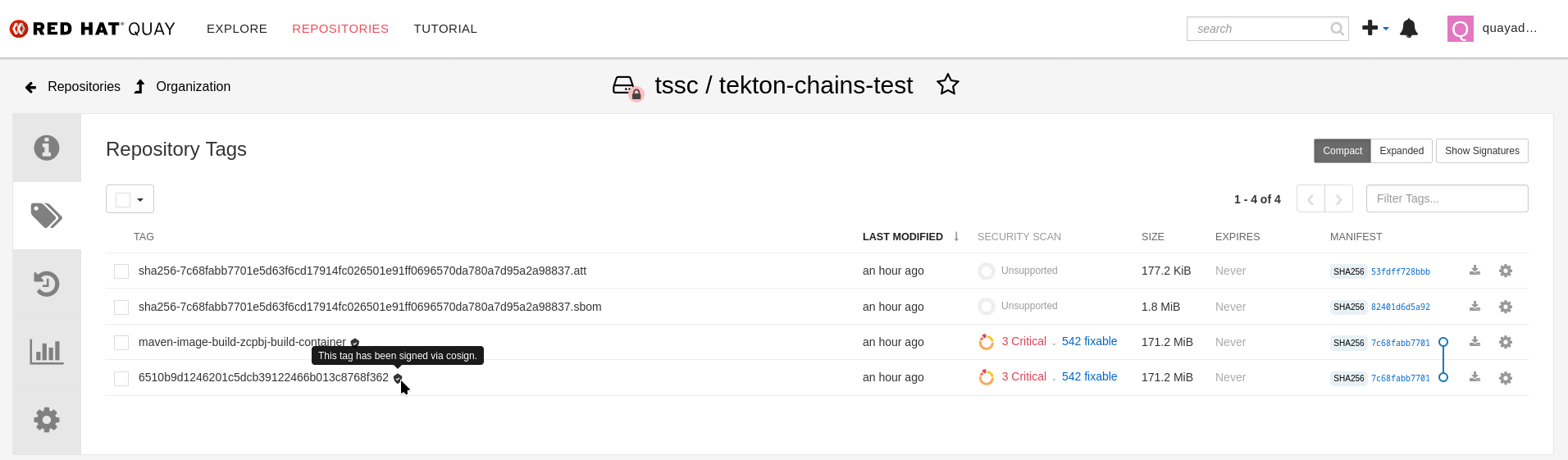
If you don’t, you’ll have to go through that exercise to create an image that has been attested by Tekton Chains |
We will now combine a few things from the previous chapters:
-
The image with the Chains attestation of type
https://slsa.dev/provenance/v0.2 -
ec(Enterprise Contract or execute conforma) validating SLSA compliance -
We will capture the
ecresult and wrap that in a custom predicate -
We will attest that predicate
-
We will then change our ClusterImagePolicy to validate this custom attestation
-
This last step effectively offloads the complex SLSA validation to
ecand its numerous SLSA policies.
-
| We’re doing this in our terminal, but naturally this should happen as part of the release pipeline. |
First, let’s get the $CHAINS_IMAGE variable again, pointing to the most recent tag that we (our Tekton Pipeline, with Chains enabled) has pushed:
cd /workspace/l3-enablement-helpers/tas-tssc/controllers/sigstore/slsa-example
source ./get-chains-image-sha.sh (1)
echo "Now validating SLSA compliance"
ec validate image \
--image $CHAINS_IMAGE \
--public-key k8s://openshift-pipelines/signing-secrets \
--rekor-url $SIGSTORE_REKOR_URL \
--policy '{
  "sources": [{
    "policy": ["oci::quay.io/enterprise-contract/ec-release-policy:latest"],
    "data": ["git::https://github.com/enterprise-contract/ec-policies//example/data"],
    "config": {
      "include": [
        "@slsa3"
      ],
      "exclude": [
        "slsa_source_correlated.source_code_reference_provided"
      ]
    }
  }]
}' --info --show-successes --output json | jq > ec-validation-predicate.json (2)| 1 | we need to source it, so the $CHAINS_IMAGE variable is available for subsequent steps |
| 2 | we’ll store the full result as json |
If you want, take look at the result:
less ec-validation-predicate.jsonHINT: Exit less with q or Q
We will attest this now as our custom predicateType https://redhat.com/ads-scholars/v2/ec-validation, using the same key that Tekton Chains used to create its SLSA attestations:
cosign attest \
  --key k8s://openshift-pipelines/signing-secrets \
  --type https://redhat.com/ads-scholars/v2/ec-validation \
  --predicate ec-validation-predicate.json \
  $CHAINS_IMAGE
For sake of completeness, we quickly verify the attestation:
cosign verify-attestation \
--type https://redhat.com/ads-scholars/v2/ec-validation \
--key k8s://openshift-pipelines/signing-secrets \
$CHAINS_IMAGE |  jq -r '.payload' | base64 -d | jq .
And now, we’ll update our policy to validate our new custom attestation for all images (glob: "**") that have been signed with the cosign key that Tekton Chains uses:
oc project policy-controller-operator
echo ""
echo "SIGSTORE_FULCIO_URL: ${SIGSTORE_FULCIO_URL}"
echo "SIGSTORE_REKOR_URL:  ${SIGSTORE_REKOR_URL}"
echo ""

cat <<EOF | oc apply -f -
apiVersion: policy.sigstore.dev/v1beta1
kind: ClusterImagePolicy
metadata:
  name: simple-cluster-image-policy
spec:
  images:
    - glob: "**"
  authorities:
    - name: keyless-no-attestation
      keyless:
        url: $SIGSTORE_FULCIO_URL
        trustRootRef: trust-root
        identities:
          - issuerRegExp: '\.redhatworkshops\.io/'
            subjectRegExp: '.*@.*redhat\.com$'
      ctlog:
        url: $SIGSTORE_REKOR_URL
        trustRootRef: trust-root
    - name: key-with-attestation-check
      key:
        secretRef:
          name: chains-cosign-pubkey
      ctlog:
        url: $SIGSTORE_REKOR_URL
        trustRootRef: trust-root
      attestations:
      - name: check-approval
        predicateType: https://redhat.com/ads-scholars/v2/ec-validation
        policy:
          type: rego
          data: |
                package sigstore

                default isCompliant = false

                isCompliant {
                  # Check that ec run attested was a success
                  input.predicate.success == true

                  # Check that @slsa3 rule set was included in the policy
                  slsa3_included

                  # Check that there are no warnings in any component
                  no_warnings
                }

                # Helper: Check if @slsa3 is in the included rule sets
                slsa3_included {
                  input.predicate.policy.sources[_].config.include[_] == "@slsa3"
                }

                # Helper: Check that no component has warnings
                no_warnings {
                  not any_component_has_warnings
                }

                # Helper: Check if any component has warnings
                any_component_has_warnings {
                  component := input.predicate.components[_]
                  count(component.warnings) > 0
                }
EOF
This rego policy could also have been externalised as previously shown, but we kept it inline for readability here.
|
And now, let’s try to deploy the attested image:
oc project student-admission-test
cd /workspace/l3-enablement-helpers/tas-tssc/controllers/sigstore/slsa-example
echo ""
echo "IMAGE: ${CHAINS_IMAGE}"
sed "s|\$IMAGE|$CHAINS_IMAGE|g" deploy.yaml | oc apply -f -
IMAGE: quay-vtm4r.apps.cluster-vtm4r.dynamic.redhatworkshops.io/tssc/tekton-chains-test@sha256:e12b7912703a8b07949b21a2fe4eb0603777d827f3d43c6082d6f71700a5334e
deployment.apps/slsa-verified-signed-image created
service/slsa-verified-signed-image unchanged
route.route.openshift.io/slsa-verified-signed-image unchanged